

South Korea Laser Seam Trackers for Shipbuilding Automation Market Led by Smart Shipyard Expansion
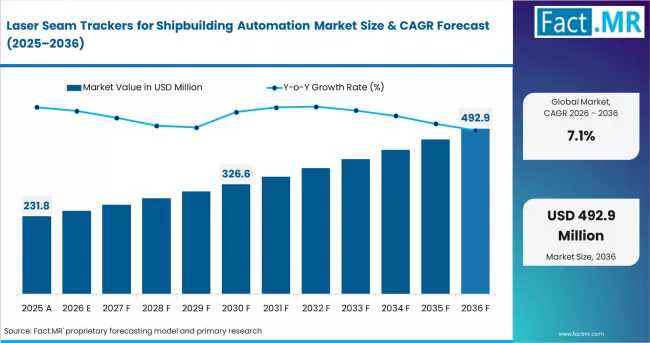
Laser Seam Trackers for Shipbuilding Automation Market
Robotic Welding Integration and Digital Shipyard Initiatives Accelerate Demand for High-Accuracy Seam Tracking Systems Through 2036
ROCKVILLE, MD, UNITED STATES, April 15, 2026 /EINPresswire.com/ -- The South Korea laser seam trackers for shipbuilding automation market is witnessing steady expansion, supported by the country’s leadership in global shipbuilding and rapid transition toward smart shipyard ecosystems. The market, aligned with global trends, is projected to grow at a CAGR of 7.6% from 2026 to 2036, driven by increasing adoption of robotic welding and precision fabrication technologies across large-scale shipyards.South Korea’s shipbuilding giants are accelerating investments in sensor-guided welding systems, enabling real-time seam detection and adaptive weld path correction. This transformation is reducing weld defects, improving throughput efficiency, and supporting high-quality vessel construction across commercial and offshore segments.
Get detailed market forecasts, competitive benchmarking, and pricing trends: https://www.factmr.com/connectus/sample?flag=S&rep_id=14723
Quick Stats
Market Growth (2026–2036): CAGR of 7.6%
Industry Focus: Automated welding and seam tracking systems
Leading Segment: Robotic Welding Cells (~50%+ share)
Leading Technology: Laser Tracking Systems (~45%+ share)
Key Applications: Hull welding, structural welding, panel fabrication
Key Players: Hyundai Heavy Industries Co., Ltd., KUKA AG, ABB Ltd., SmartRay GmbH, IPG Photonics Corporation
Executive Insight for Decision Makers
South Korea is transitioning toward fully automated shipyard operations, where seam tracking systems play a critical role in ensuring welding precision across large and complex steel structures.
Strategic Priorities:
Integrate laser seam tracking with robotic welding cells
Invest in digital shipyard and smart fabrication technologies
Enhance weld quality consistency and reduce rework rates
Risk of Delay:
Loss of global competitiveness in high-value shipbuilding
Increased operational inefficiencies and production delays
Inability to meet evolving quality and compliance standards
Market Dynamics
Key Growth Drivers
Strong presence of large-scale shipbuilding companies
Government-backed smart shipyard and automation initiatives
Rising adoption of robotic welding for precision fabrication
Increasing need for thermal distortion compensation in welding
Key Restraints
High capital investment for automation systems
Integration challenges with legacy shipyard infrastructure
Dependence on cyclical shipbuilding demand
Emerging Trends
Deployment of AI-enabled seam tracking systems
Expansion of real-time welding path correction technologies
Integration of laser sensors with digital twin systems
Increasing adoption of ISO-compliant automated welding processes
Segment Analysis
Leading Segment:
Robotic welding cells dominate, accounting for over 50% share, driven by automation in hull and structural welding processes.
Technology Leadership:
Laser tracking systems lead due to their ability to provide high-precision seam detection across reflective metal surfaces.
Applications:
Hull fabrication
Structural assembly
Panel and module welding
Strategic Importance:
These segments are critical for South Korea’s modular shipbuilding approach, ensuring speed, accuracy, and scalability.
Supply Chain Analysis (Critical Insight)
Value Chain Structure
Raw Material Suppliers: Optical sensors, laser components, semiconductor devices
Manufacturers: Seam tracking system providers and robotic welding solution companies
Integrators/Distributors: Automation firms deploying systems in shipyards
End-Users: Major shipbuilders and offshore structure manufacturers
Who Supplies Whom
Component suppliers deliver laser and vision modules to seam tracking manufacturers
Seam tracking companies integrate systems into robotic welding platforms
Automation integrators deploy solutions across Hyundai and other shipyards
Shipbuilders utilize systems for precision welding in hull and structural fabrication
Pricing Trends
Premium Systems Dominate:
High-precision laser tracking systems command premium pricing due to advanced sensing capabilities.
Pricing Influencers:
Optical component costs
System integration complexity
Customization for shipyard workflows
Compliance with welding standards
Margin Outlook:
Higher margins are observed in integrated automation solutions, while standalone components face moderate price competition.
Regional Analysis – South Korea Focus
South Korea stands as a global hub for advanced shipbuilding, with strong adoption of automation technologies across major shipyards.
Growth Drivers
Expansion of K-Shipbuilding innovation programs
Increasing investments in digital shipyard infrastructure
Strong export demand for commercial and offshore vessels
Market Position
Among the top adopters of robotic welding systems globally
Strong collaboration between industrial automation providers and shipbuilders
Developed Market Advantage
Focus on technology upgrades and precision engineering
Early adoption of next-generation welding automation systems
Competitive Landscape
Market Structure: Moderately consolidated
Key Players
Hyundai Heavy Industries Co., Ltd.
KUKA AG
ABB Ltd.
SmartRay GmbH
IPG Photonics Corporation
Scansonic MI GmbH
Competitive Strategies
Investment in laser sensing innovation
Strengthening robotic welding integration capabilities
Expanding automation portfolios for shipbuilding applications
Focus on precision, durability, and system reliability
Strategic Takeaways
For Manufacturers
Develop high-accuracy seam tracking systems tailored for shipbuilding
Enhance compatibility with robotic and digital fabrication systems
For Investors
Focus on companies aligned with smart shipyard transformation
Target technologies enabling automation and precision welding
For Distributors
Position solutions as essential for productivity and quality improvement
Emphasize cost savings from reduced weld defects
Future Outlook
The South Korea market is expected to remain at the forefront of shipbuilding automation innovation, driven by continued investment in smart manufacturing and robotics.
Growth Opportunities:
AI-powered seam tracking
Fully automated welding systems
Integration with digital twin and Industry 4.0 platforms
Conclusion
South Korea’s laser seam trackers for shipbuilding automation market is evolving rapidly, driven by the country’s commitment to precision engineering and smart shipyard development. As automation becomes critical for maintaining global leadership, adoption of advanced seam tracking technologies will be pivotal.
Unlock 360° insights for strategic decision making and investment planning: https://www.factmr.com/checkout/14723
Why This Market Matters:
It enables South Korea’s shipbuilding industry to achieve higher productivity, superior weld quality, and global competitiveness, positioning it as a benchmark for next-generation automated fabrication systems.
To View Related Report:
Dental Laser Market https://www.factmr.com/report/172/dental-lasers-market
Alexandrite Laser Treatment Market https://www.factmr.com/report/870/alexandrite-gemstone-lasers-market
Automotive Laser Lighting Market https://www.factmr.com/report/884/automotive-laser-lighting-market
Laser Diode Market https://www.factmr.com/report/1456/laser-diode-market
S. N. Jha
Fact.MR
+1 628-251-1583
email us here
Legal Disclaimer:
EIN Presswire provides this news content "as is" without warranty of any kind. We do not accept any responsibility or liability for the accuracy, content, images, videos, licenses, completeness, legality, or reliability of the information contained in this article. If you have any complaints or copyright issues related to this article, kindly contact the author above.
