

Global Single-Phase Dielectric Immersion Fluids Market Led by North America, Key Players Shell, 3M, ExxonMobil
Single-Phase Dielectric Immersion Fluids Market
AI Data Center Expansion, PFAS-Free Regulations, and Energy Efficiency Mandates Accelerate Market Toward USD 998 Million by 2036
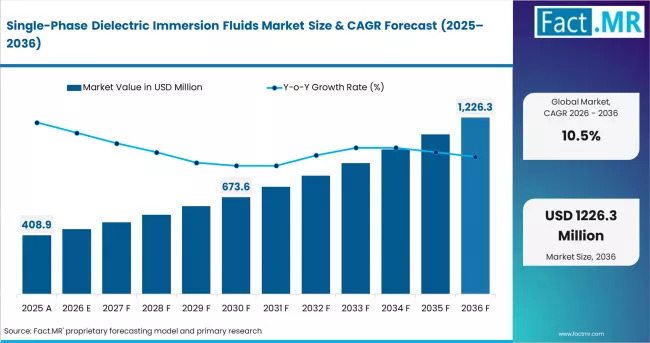
ROCKVILLE, MD, UNITED STATES, April 15, 2026 /EINPresswire.com/ -- According to the latest analysis by Fact.MR, the global single-phase dielectric immersion fluids market is valued at USD 408.9 million in 2026, following USD 370.0 million in 2025, and is projected to reach USD 998.0 million by 2036, expanding at a CAGR of 10.5%.Get detailed market forecasts, competitive benchmarking, and pricing trends: https://www.factmr.com/connectus/sample?flag=S&rep_id=14716
The market is expected to generate an incremental opportunity of USD 589.1 million over the forecast period.
The transformation is being driven by:
Rapid expansion of AI and hyperscale data centers
Transition from air cooling to direct liquid immersion cooling
Increasing regulatory pressure in Europe, particularly Germany, for PFAS-free and energy-efficient solutions
Germany is emerging as a high-value growth hub, driven by strict compliance frameworks and strong industrial digitalization.
Quick Stats
Market Size (2026): USD 408.9 million
Market Size (2027 est.): ~USD 451.8 million
Forecast Value (2036): USD 998.0 million
CAGR (2026–2036): 10.5%
Incremental Opportunity: USD 589.1 million
Leading Segment: Synthetic Hydrocarbon Fluids (42% share)
Leading Application: Data Centers (57% share)
Leading Region: North America (innovation) / Germany (regulation-driven growth)
Key Players: Shell plc, ExxonMobil Corporation, FUCHS SE, 3M, TotalEnergies
Executive Insight for Decision Makers
A structural shift is underway from commodity cooling fluids to certified, performance-validated solutions.
OEMs & Manufacturers:
Must prioritize Intel-certified, PFAS-free formulations and invest in thermal validation services.
Investors:
Focus on companies aligned with hyperscale procurement ecosystems and sustainability compliance.
Risk of Inaction:
Suppliers lacking certification and compliance risk exclusion from high-value AI data center contracts, especially in Europe.
Market Dynamics
Key Growth Drivers
Surge in AI and HPC workloads increasing heat density
Limitations of traditional air cooling systems
EU regulations promoting energy efficiency and PFAS-free fluids
Hyperscale investments in cloud infrastructure
Key Restraints
High qualification and certification costs
Limited supply of PFAS-free compliant fluids
Long OEM testing and validation cycles
Emerging Trends
Shift toward bio-based and low-GWP fluids
Bundling of thermal validation and consulting services
Long-term hyperscaler supply contracts
Increasing price premium (15–30%) for certified fluids
Segment Analysis
Leading Segment:
Synthetic hydrocarbons hold 42% market share (2026) due to PFAS-free chemistry and OEM compatibility.
Fastest-Growing Segment:
Bio-based and low-GWP fluids gaining traction due to EU sustainability mandates.
Application Breakdown:
Data Centers: 57%
Telecom
Industrial Systems
EV Cooling
Strategic Importance:
Data centers dominate due to AI cluster density and energy efficiency requirements, making them the primary revenue driver.
Supply Chain Analysis (Critical Insight)
Value Chain Structure
Raw Material Suppliers:
Petrochemical and specialty chemical providers supplying base oils, fluorochemicals, and bio-feedstocks
Manufacturers / Producers:
Global oil & chemical companies producing engineered dielectric fluids
System Integrators / OEMs:
Cooling system providers integrating fluids into immersion cooling infrastructure
Distributors:
Regional distributors supplying to data center operators and industrial clients
End-Users:
Hyperscale cloud providers
Colocation data centers
Telecom operators
Industrial HPC users
Who Supplies Whom
Chemical companies → supply certified fluids to → OEMs & system integrators
OEMs → deploy solutions to → hyperscalers & enterprise data centers
Distributors → support mid-market adoption
Key Insight:
Once a fluid is approved by an OEM or hyperscaler, switching costs are high, locking suppliers into long-term contracts.
Pricing Trends
Commodity vs Premium:
Mineral oils: Low-cost, declining share
Certified fluids: 15–30% premium pricing
Key Pricing Drivers:
Certification (Intel/OEM validation)
PFAS compliance
Thermal performance
Supply availability
Margin Insights:
Premium fluids deliver higher margins due to limited suppliers and high entry barriers.
Regional Analysis
Top 5 Countries by CAGR (2026–2036)
United States – 11.3%
China – 11.0%
Germany – 10.6%
Japan – 10.0%
South Korea – 9.7%
Germany Spotlight
Germany is a regulation-driven growth market, supported by:
EU Energy Efficiency Directive compliance
Expansion of data center operators
Strong industrial and digital infrastructure
Developed vs Emerging Markets
Developed Markets (Germany, U.S., Japan):
High adoption of certified, premium fluids
Emerging Markets (China, ASEAN):
Focus on volume expansion and infrastructure scaling
Competitive Landscape
Market Structure:
Semi-consolidated at the premium end
Key Players:
Shell plc
ExxonMobil Corporation
FUCHS SE
3M
The Chemours Company
TotalEnergies
Engineered Fluids
Submer Technologies
LiquidStack Inc.
Green Revolution Cooling
Competitive Strategies
Certification-led market entry
Strategic partnerships with OEMs
Investment in PFAS-free innovation
Long-term supply agreements
Strategic Takeaways
For Manufacturers
Invest in certification and compliance
Develop bio-based and PFAS-free fluids
For Investors
Target companies integrated into AI data center ecosystems
For Distributors & Marketers
Focus on value-added services like validation and consulting
Future Outlook
The market is transitioning toward mainstream infrastructure adoption.
AI-driven computing will continue to increase thermal loads
Sustainability regulations will accelerate fluid innovation
Immersion cooling will become standard for high-density computing
Germany will remain a key European growth engine, driven by compliance and advanced infrastructure.
Conclusion
The global single-phase dielectric immersion fluids market is entering a high-growth, high-barrier phase, where certification, sustainability, and performance define success.
For decision-makers, the opportunity lies in aligning with:
AI infrastructure expansion
Regulatory compliance (especially in Germany and Europe)
Long-term hyperscale partnerships
Why This Market Matters
As data becomes the backbone of modern economies, cooling technology is no longer a support function it is a strategic enabler.
Single-phase dielectric immersion fluids are at the center of this shift, powering the next generation of energy-efficient, high-performance digital infrastructure.
Unlock 360° insights for strategic decision making and investment planning:
To View Our Related Report: https://www.factmr.com/checkout/14716
Dielectric Ceramics Market:https://www.factmr.com/report/4107/dielectric-ceramics-market
Dielectric Gases Market:https://www.factmr.com/report/4805/dielectric-gases-market
Dielectric Fluids Market: https://www.factmr.com/report/721/dielectric-fluids-market
BOPP Dielectric Films Market: https://www.factmr.com/report/bopp-dielectric-films-market
S. N. Jha
Fact.MR
+1 628-251-1583
email us here
Legal Disclaimer:
EIN Presswire provides this news content "as is" without warranty of any kind. We do not accept any responsibility or liability for the accuracy, content, images, videos, licenses, completeness, legality, or reliability of the information contained in this article. If you have any complaints or copyright issues related to this article, kindly contact the author above.
