

Global Automotive Windshield Washer System Market: From Commodity to ADAS-Critical Subsystem
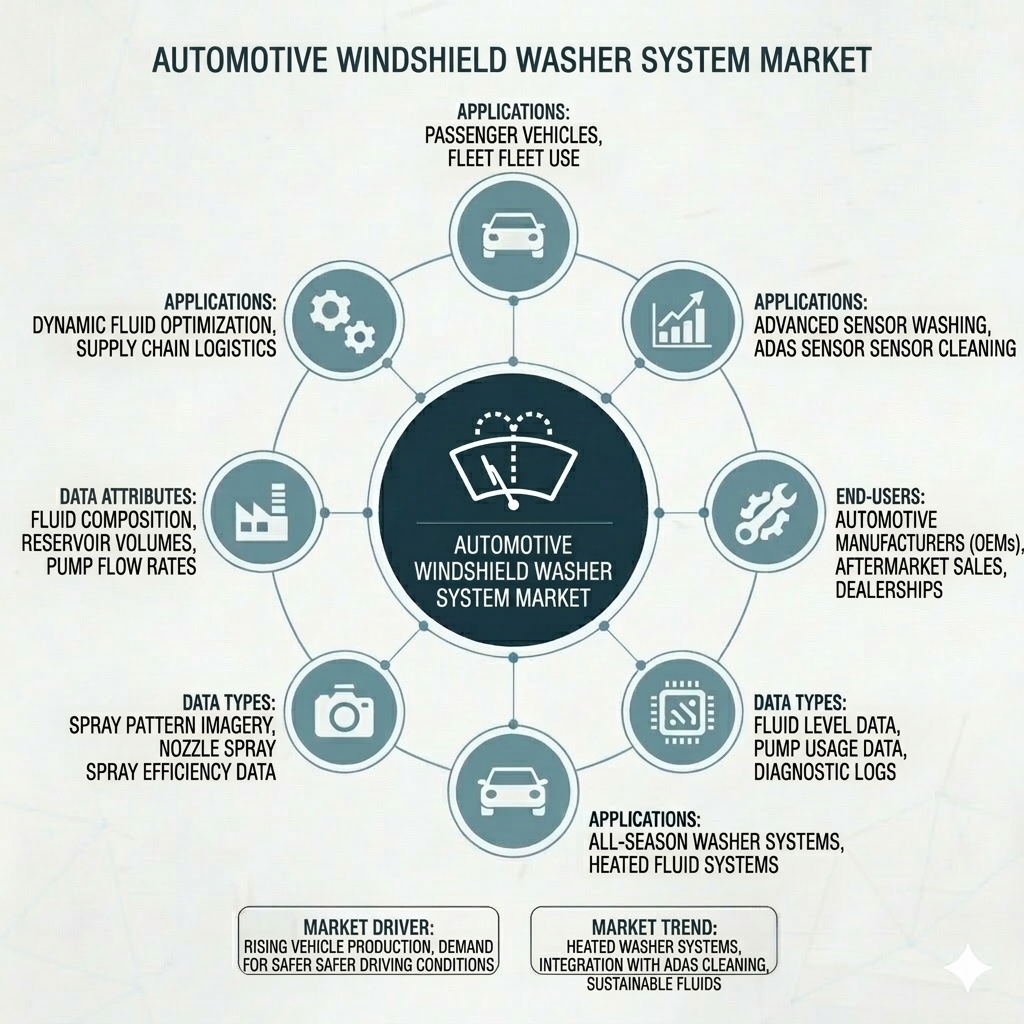
Automotive Windshield Washer System Market
Demand is estimated to grow to USD 3,670.0 million in 2026 and USD 5,699.5 million by 2036. FMI projects a CAGR of 4.5% during the forecast period.
NEWARK, DE, UNITED STATES, March 17, 2026 /EINPresswire.com/ -- The global automotive windshield washer system market is currently undergoing a significant technological renaissance. Once viewed as a simple commodity consisting of a plastic reservoir and a basic pump, the system has evolved into a high-tech, ADAS-enabling subsystem. According to analysis by Future Market Insights (FMI), the market was valued at USD 3,512.0 million in 2025 and is projected to reach USD 5,699.5 million by 2036, growing at a steady CAGR of 4.5%.
This growth trajectory represents an absolute dollar expansion of over USD 2 billion across the decade. This surge is not merely a byproduct of rising vehicle production; it is driven by a fundamental shift in vehicle architecture where integrated spray systems, heated nozzles, and electronic fluid-level monitoring are becoming standard requirements for modern, sensor-heavy vehicles.
The Evolution of Technology: Efficiency and Automation
The market is currently bifurcated between traditional mechanical setups and advanced electrical systems. Electrical technology is projected to hold a commanding 65% market share in 2026. This dominance is fueled by the integration of rain sensors and smart automation that allows the vehicle to adjust fluid pressure and spray patterns without driver intervention.
One of the most significant innovations is the shift toward integrated blade-spray systems, such as Bosch’s "Jet Wiper" technology. By applying fluid directly through the wiper arm rather than an expansive mist from the hood, these systems reduce fluid consumption by up to 40%. This precision is vital for high-speed driving on German autobahns or navigating the dense urban dust of Chinese megacities, ensuring that visibility is restored instantly without the "blind moment" caused by conventional spray mists.
Get Access of Report Sample:
https://www.futuremarketinsights.com/reports/sample/rep-gb-1843
Segment Spotlight: The 2-3 Liter Standard
In terms of capacity, the 2-3 liter reservoir is expected to dominate with a 35% share in 2026. This volume is considered the "Goldilocks" zone for passenger cars—providing enough fluid for extended use while minimizing vehicle weight and footprint, which is essential for the range-extension goals of modern Electric Vehicles (EVs).
Market Drivers: Safety, ADAS, and Global Expansion
1. The ADAS Imperative
Advanced Driver Assistance Systems (ADAS) rely on cameras and LiDAR sensors often mounted behind the windshield. If the glass is obscured by dirt or ice, the safety system fails. Consequently, Tier-1 suppliers like Bosch, Valeo, and HELLA are now bundling washer systems with camera-cleaning modules. In 2023, over 50% of new vehicles included at least one ADAS feature, making specialized cleaning nozzles a high-margin necessity rather than an optional luxury.
2. Regulatory and Environmental Pressure
Clear visibility is a factor in approximately 25% of road accidents globally. Regulatory frameworks like FMVSS in the USA and UNECE in Europe are tightening performance criteria for visibility systems. Furthermore, as the industry moves toward sustainability, manufacturers like Valeo are introducing "green" components, such as the Canopy wiper blade, made from 80% recycled or renewable materials.
3. Regional Growth Dynamics
While the global market for windshield washer systems is growing steadily, regional trajectories are increasingly defined by local vehicle preferences and technological adoption. India is projected to lead this growth with a 6.2% CAGR, driven by a massive surge in passenger vehicle ownership and a high-volume aftermarket for replacement components. China follows with a 5.5% CAGR, fueled by rapid urbanization and the aggressive integration of Advanced Driver Assistance Systems (ADAS) within its domestic electric vehicle brands. In the United States, the market is advancing at a 4.3% CAGR, where the continued dominance of SUVs and light trucks necessitates high-performance, heavy-duty fluid delivery systems capable of handling rugged conditions.
In Europe, Germany is recording a 3.5% CAGR, supported by its leadership in the luxury OEM segment and the stringent safety requirements of high-speed driving environments. Meanwhile, Japan contributes a 3.3% CAGR, maintaining its position as a vital exporter of precision-engineered components and integrating advanced washer technologies into global EV platforms.
Understanding the Competitive Landscape
The market is highly concentrated at the top, with Tier-1 companies (Mitsuba, Continental, Bosch, etc.) controlling 50-55% of the value. These players benefit from "pricing asymmetry." While a basic pump for a budget car might sell for USD 15, a high-tech system for a luxury ADAS vehicle—complete with heated jets and sensor cleaning—can fetch up to USD 150.
Tier-2 players, such as Cebi and Prabha Engineering, remain vital by catering to the massive aftermarket and regional manufacturing needs, particularly in South Asia and Eastern Europe.
Challenges: Supply Chain and Liability
Despite the optimistic growth, the industry faces specific "sourcing fragility."
• Motor Supply: The small DC motors that power washer pumps are heavily concentrated in a few manufacturing hubs in China and Japan.
• Component Competition: Heated nozzles utilize PTC (Positive Temperature Coefficient) elements. These same elements are in high demand for EV battery thermal management and seat heaters, leading to potential supply bottlenecks during winter peaks.
• Liability Risks: As washer systems become integral to ADAS, a failure to clean a sensor is no longer just a convenience issue—it is a safety failure. This creates significant product liability exposure for OEMs and their suppliers.
Recent Industry Milestones
• January 2026: Bosch releases the Jet Wiper Blade Aero, further refining the precision of fluid delivery.
• March 2025: Acura launches the 2025 ADX featuring a blade-integrated spray system that cuts fluid waste by 40%.
• May 2024: Valeo’s Canopy blade sets a new benchmark for sustainability, reducing CO2 emissions by 61% during production.
Future Outlook: 2026–2036
Looking toward the next decade, several "Next-Gen" trends will define the winners in this space:
• Ultrasonic Nozzles: These use high-frequency vibrations to atomize fluid, providing a more thorough clean with even less water.
• Self-Cleaning Sensors: Integration of air-blast and fluid-spray combinations to keep LiDAR and cameras operational in autonomous "Level 4" vehicles.
• Heated Jet Adoption: Once a luxury feature, heated systems are becoming standard for EVs in cold climates to prevent the fluid from freezing in the lines, which is crucial for maintaining safety systems in regions like the Northern USA and Scandinavia.
Brows More Industry Reports
Automotive Washer System Market
https://www.futuremarketinsights.com/reports/automotive-washer-systems-market
Demand for Automotive Washer System in Japan
https://www.futuremarketinsights.com/reports/japan-automotive-washer-system-market
Automotive Front Windshield Market
https://www.futuremarketinsights.com/reports/automotive-front-windshield-market
Sudip Saha
Future Market Insights Inc.
+1 347-918-3531
email us here
Legal Disclaimer:
EIN Presswire provides this news content "as is" without warranty of any kind. We do not accept any responsibility or liability for the accuracy, content, images, videos, licenses, completeness, legality, or reliability of the information contained in this article. If you have any complaints or copyright issues related to this article, kindly contact the author above.
