

Protein/Antibody Engineering Market Forecast 2026–2036: Global Market to Reach USD 18.4 Billion by 2036 at 16.2% CAGR
Protein/Antibody Engineering Market
AI-driven protein and antibody engineering is accelerating biologics innovation, improving clinical success rates, and reshaping global biotech R&D strategies.
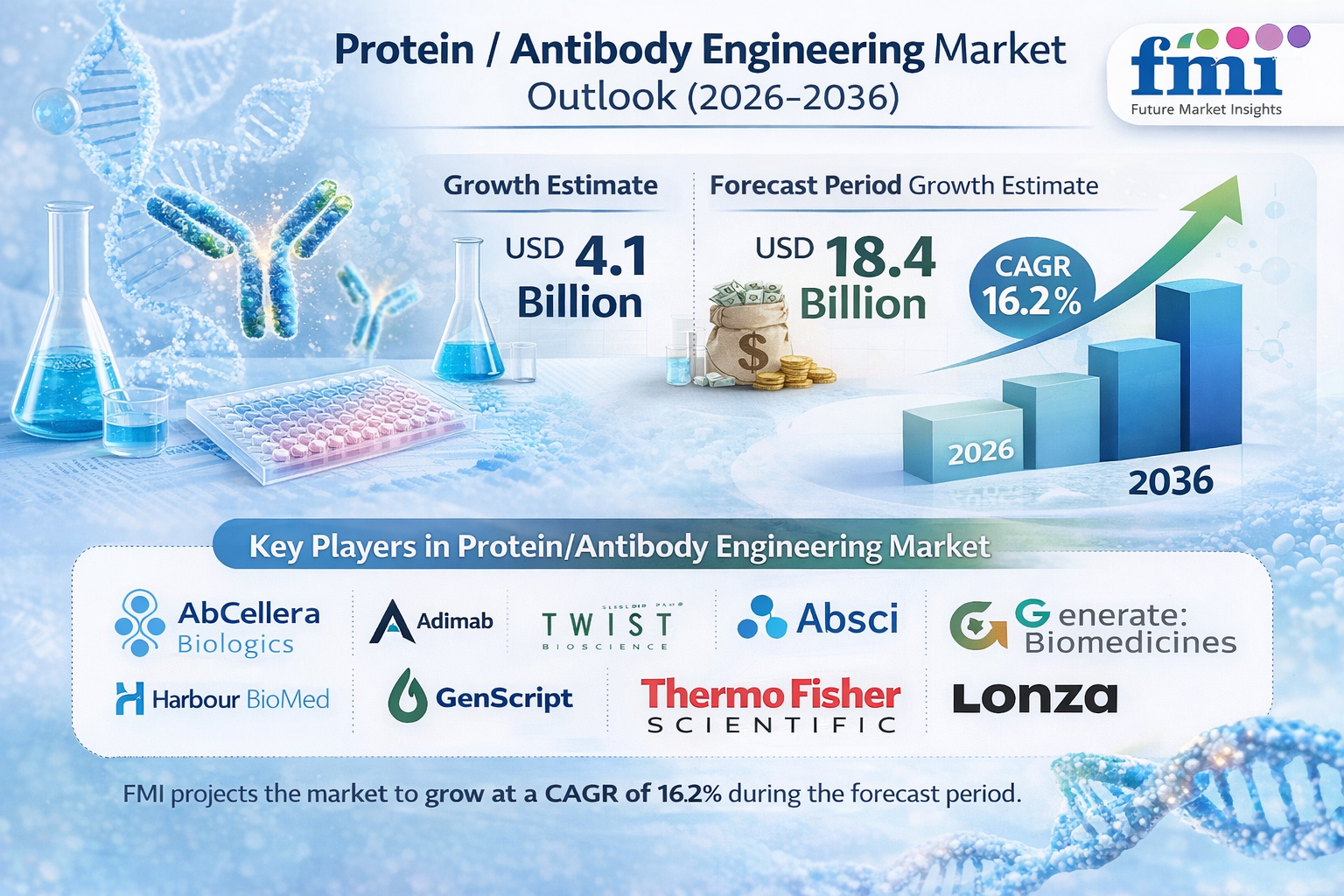
NEWARK, DE, UNITED STATES, February 23, 2026 /EINPresswire.com/ -- The global protein/antibody engineering market is entering a high-acceleration phase, driven by mounting pressure to improve biologic drug success rates and reduce costly late-stage clinical failures. Valued at USD 3.5 billion in 2025, the market is projected to reach USD 4.1 billion in 2026 and surge to USD 18.4 billion by 2036, expanding at a CAGR of 16.2% during the forecast period, according to Future Market Insights (FMI).
As biologics pipelines grow more complex, pharmaceutical companies are reallocating capital toward predictive engineering platforms that identify safety, stability, and manufacturability risks earlier in development. Engineering today extends far beyond binding affinity optimization—it now addresses aggregation prevention, immunogenicity reduction, half-life extension, and scalable expression design.
Explore trends before investing – request a sample report today! https://www.futuremarketinsights.com/reports/sample/rep-gb-214
Recent regulatory data reinforces this strategic pivot. In 2024, 37 of 50 novel drugs secured approval in the first FDA review cycle, signaling that companies mastering chemistry, manufacturing, and developability hurdles early are gaining regulatory advantage. The data validates the value of integrated “design-build-test” engineering workflows in accelerating time to approval.
Carl Hansen, Founder & CEO of AbCellera, emphasized this shift during the expansion of the company’s oncology collaboration with AbbVie, stating that advanced T-cell engager platforms are being leveraged to accelerate next-generation immunotherapies. Such partnerships illustrate how engineering specialists are becoming embedded extensions of big pharma R&D ecosystems.
Market Definition and Scope
The protein and antibody engineering industry comprises technologies, services, and computational platforms used to modify amino acid sequences and protein structures to enhance specificity, solubility, stability, and therapeutic efficacy. It covers both rational protein design and directed evolution approaches applied to monoclonal antibodies, fusion proteins, vaccines, and enzymes.
Importantly, the market valuation reflects revenues generated within the engineering and optimization value chain. It excludes commercial biologics manufacturing, large-scale CMO revenues, clinical trial expenditures, and finished drug sales.
Structural Growth Drivers
Market expansion is anchored in three core demand accelerators:
• Rising chronic disease prevalence, particularly oncology, driving demand for precision biologics
• Integration of AI and machine learning to compress discovery timelines
• Patent expirations of blockbuster biologics, increasing demand for differentiated biosimilars and “biobetters”
FMI’s projections are based on validated corporate R&D data, regulatory approvals, partnership structures, and bottom-up revenue modeling rather than speculative third-party estimates.
Segment Insights
Monoclonal antibodies remain the backbone of engineered biologics, accounting for 25.3% of market share in 2026. However, the growth frontier lies in multi-specific antibodies, antibody-drug conjugates (ADCs), and T-cell engagers requiring sophisticated molecular engineering.
Rational Protein Design dominates technology adoption with a 59.7% share in 2026. AI-powered structural modeling now enables targeted mutation predictions, minimizing reliance on massive physical libraries and reducing per-candidate screening costs.
Biopharmaceutical companies represent 41.2% of end-user demand. Increasingly, large pharma firms are outsourcing early discovery to specialized engineering platforms to access proprietary libraries and AI capabilities without heavy infrastructure investment.
Executive Takeaways
Between 2026 and 2036, competitive differentiation will depend on:
• Integrating generative AI with wet-lab validation
• Targeting difficult-to-drug proteins such as GPCRs and ion channels
• Structuring milestone-based, royalty-aligned partnerships
According to Nandini Roy Choudhury, Principal Consultant at Future Market Insights, tightening regulatory scrutiny and escalating R&D expenditure could compress commercialization margins, making early-stage engineering efficiency critical for long-term profitability.
Regional Outlook
Growth patterns reveal strong globalization of biotech R&D. China is projected to expand at 21.9% CAGR through 2036, followed by India at 20.3%, Germany at 18.7%, the UK at 15.4%, the USA at 13.8%, and Brazil at 12.2%.
Asia Pacific is rapidly evolving from a manufacturing hub into a biologic innovation center, fueled by aggressive government investment and expanding CRO ecosystems. North America continues to lead in AI-native drug discovery platforms, supported by high pharmaceutical spending and dense biopharma clusters. Europe maintains leadership in complex multispecific antibody development and regulatory governance.
Drivers, Restraints, and Opportunities
The primary growth catalyst is the increasing complexity of disease targets requiring beyond-nature biologic solutions. Advanced modalities such as antibody-drug conjugates and T-cell engagers demand high-precision engineering platforms capable of balancing potency with safety.
Manufacturability remains a significant restraint. Proteins optimized computationally may encounter scalability challenges in large bioreactors, increasing late-stage risk. Additionally, dense intellectual property landscapes around antibody libraries and genome-editing tools create entry barriers.
Key opportunity clusters include:
• Generative AI–enabled antibody creation
• Biosimilar optimization for interchangeability
• Humanized in vivo discovery models that improve translational success
Competitive Landscape
Competition is increasingly defined by convergence between computational biology and high-throughput validation systems. Platform-based revenue models—combining upfront payments, milestones, and royalties—are replacing traditional service-only contracts.
Strategic alliances are expanding across oncology and immunology pipelines, with engineering firms positioning themselves as long-term innovation partners rather than transactional vendors.
Key Players
AbCellera Biologics
Adimab
Twist Bioscience
Absci
Generate:Biomedicines
Harbour BioMed
Genscript
Bio-Rad Laboratories
Thermo Fisher Scientific
Lonza
Browse Related Insights
Protein Condiments Market: https://www.futuremarketinsights.com/reports/protein-condiments-market
Protein Texturizers and Functional Binders Market: https://www.futuremarketinsights.com/reports/protein-texturizers-and-functional-binders-market
Protein Flavor Masking Agents Market: https://www.futuremarketinsights.com/reports/protein-flavor-masking-agents-market
About Future Market Insights (FMI)
Future Market Insights, Inc. (FMI) is an ESOMAR-certified, ISO 9001:2015 market research and consulting organization, trusted by Fortune 500 clients and global enterprises. With operations in the U.S., UK, India, and Dubai, FMI provides data-backed insights and strategic intelligence across 30+ industries and 1200 markets worldwide.
Sudip Saha
Future Market Insights Inc.
+ +1 347-918-3531
email us here
Legal Disclaimer:
EIN Presswire provides this news content "as is" without warranty of any kind. We do not accept any responsibility or liability for the accuracy, content, images, videos, licenses, completeness, legality, or reliability of the information contained in this article. If you have any complaints or copyright issues related to this article, kindly contact the author above.
