

Wheelchair Mounted Robotic Arm Market is expected to reach US$ 27.02 Million by 2033 | DataM Intelligence
Wheelchair Mounted Robotic Arm Market
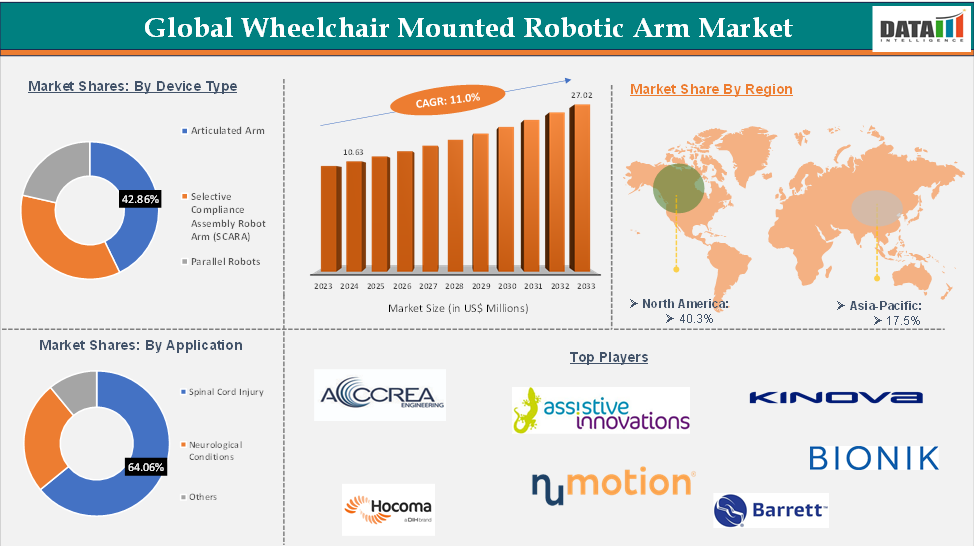
The Wheelchair Mounted Robotic Arm Market is expected to reach at a CAGR of 11.0% during the forecast period 2025-2033.
The Wheelchair Mounted Robotic Arm Market is rapidly growing, driven by advancements in assistive robotics, increasing demand for independence, and aging populations.”
AUSTIN, TX, UNITED STATES, January 6, 2026 /EINPresswire.com/ -- Market Overview: — DataM Intelligence
The Wheelchair Mounted Robotic Arm Market has witnessed significant growth in recent years, driven by technological advancements, increasing demand for assistive devices, and a growing global population of individuals with mobility impairments. These robotic arms are designed to enhance independence for wheelchair users, enabling them to perform everyday tasks such as eating, drinking, and handling objects without external assistance. The market encompasses a variety of products, from simple mechanical arms to advanced robotic solutions integrated with AI and IoT capabilities. As healthcare providers and rehabilitation centers increasingly focus on patient autonomy, the adoption of these devices has accelerated, creating lucrative opportunities for manufacturers and service providers.
To Download Sample Report Here: https://www.datamintelligence.com/download-sample/wheelchair-mounted-robotic-arm-market
According to DataM Intelligence, The Global Wheelchair Mounted Robotic Arm Market was valued at approximately USD 10.63 million in 2024 and is projected to reach USD 27.02 million by 2033, growing at a CAGR of around 11.0% during the forecast period. The growth is fueled by the rising prevalence of disabilities, aging populations in developed regions, and continuous technological innovations in robotics and human-machine interfaces. The leading segment in this market is electric wheelchair mounted robotic arms, primarily due to their ease of use, precision, and compatibility with powered wheelchairs. Geographically, North America dominates the market, owing to well-established healthcare infrastructure, high disposable income, and early adoption of assistive technologies, followed closely by Europe and Asia-Pacific, where emerging economies are increasingly investing in healthcare accessibility solutions.
Key Highlights from the Report:
The Market is expected to reach USD 27.02 million by 2033, with a CAGR of 11%.
Electric wheelchair mounted robotic arms dominate product adoption due to advanced features.
North America leads the market, driven by high healthcare expenditure and awareness.
Integration of AI and IoT in robotic arms is enhancing user independence.
Rising geriatric population and disabled individuals fuel market demand.
Increasing collaborations between tech companies and healthcare providers are accelerating innovation.
Market Segmentation:
The Wheelchair Mounted Robotic Arm Market can be segmented based on product type, end-user, and application.
By Product Type: The market primarily includes electric robotic arms and manual robotic arms. Electric variants dominate due to their precision, ease of operation, and ability to perform complex tasks with minimal physical effort. Manual robotic arms, though less expensive, are often preferred in low-income regions due to cost considerations and simplicity.
By End-User: The market caters to individual consumers, rehabilitation centers, hospitals, and care facilities. Among these, individual consumers represent the largest segment as personal independence drives adoption. Rehabilitation centers and hospitals contribute significantly by providing robotic arms as part of therapy and rehabilitation programs for patients with spinal cord injuries, cerebral palsy, or age-related mobility challenges.
By Application: Applications include daily activities assistance, rehabilitation therapy, and workplace support. Daily activity assistance dominates the market, as robotic arms allow users to perform essential tasks like eating, drinking, personal hygiene, and object manipulation. Rehabilitation therapy applications are witnessing growth as robotic arms are increasingly used in therapeutic exercises to enhance mobility, dexterity, and independence.
Speak to Our Analyst and Get Customization in the report as per your requirements: https://www.datamintelligence.com/customize/wheelchair-mounted-robotic-arm-market
Regional Insights:
North America leads the global wheelchair mounted robotic arm market due to the presence of advanced healthcare infrastructure, high R&D investment in assistive technology, and strong awareness among end-users. The United States is a major contributor, supported by government initiatives that encourage adoption of assistive devices for disabled and elderly populations.
Europe follows closely, with countries such as Germany, the UK, and France witnessing rapid adoption in hospitals and rehabilitation centers. Government subsidies and healthcare insurance policies further support market growth in the region.
Asia-Pacific is emerging as a high-growth market due to increasing investments in healthcare technology, growing geriatric populations, and rising awareness about accessibility solutions. Countries such as Japan, China, and India are expected to witness significant growth, driven by affordability improvements and rising middle-class disposable income.
Latin America and Middle East & Africa represent smaller but steadily growing markets, primarily due to increasing government support and nonprofit initiatives aimed at enhancing the quality of life for disabled individuals.
Market Dynamics:
Market Drivers: The primary driver of the wheelchair mounted robotic arm market is the increasing demand for assistive devices that enhance independence and quality of life for disabled and elderly individuals. Technological advancements in robotics, AI, and IoT are enabling more precise, intuitive, and versatile robotic arms. Additionally, growing awareness among patients and healthcare providers about the benefits of robotic arms, coupled with government initiatives supporting accessibility and inclusion, is significantly contributing to market growth.
Market Restraints: High cost of advanced robotic arms remains a major challenge, limiting accessibility for low-income users, especially in developing countries. Complex integration with existing wheelchair systems and maintenance requirements also pose barriers for adoption. Regulatory challenges and lack of standardization in assistive devices can further slow down market growth.
Market Opportunities: There is a substantial opportunity for market expansion through affordable robotic arms tailored for emerging economies. Collaboration between robotics manufacturers, healthcare providers, and insurance companies can increase adoption by reducing costs and offering financial assistance. Additionally, advancements in AI, machine learning, and sensor technology can enable more intelligent robotic arms that provide adaptive assistance, creating a new wave of innovation and growth in the market.
Looking For Full Report? Get it Here: https://www.datamintelligence.com/buy-now-page?report=wheelchair-mounted-robotic-arm-market
Frequently Asked Questions (FAQs):
How big is the Wheelchair Mounted Robotic Arm Market in 2025?
Who are the key players in the global wheelchair mounted robotic arm market?
What is the projected growth rate of the wheelchair mounted robotic arm market?
What is the market forecast for the wheelchair mounted robotic arm market by 2032?
Which region is estimated to dominate the wheelchair mounted robotic arm market through the forecast period?
Company Insights:
Key players operating in the Wheelchair Mounted Robotic Arm Market include:
Accrea Engineering
Assistive Innovations BV
Kinova Inc
Hocoma AG
Bionik Laboratories
Barrett Technology
Numotion
Recent Developments:
United States:
Nov 2025: ARPA‑H awarded up to USD 41.5 million to the RAMMP consortium (Pitt, CMU, Northeastern, Kinova) to develop an autonomous wheelchair with an integrated AI‑enabled robotic arm to enhance independent living for people with disabilities.
Nov 2025: FDA cleared a next‑generation wheelchair‑mounted robotic arm aimed at supporting independent daily living for users with upper‑limb impairments, signaling regulatory support for more advanced assistive manipulators.
Oct 2025: Microsoft launched collaborations with U.S. rehabilitation centers to embed AI‑based motion‑learning software into assistive robotic arms, improving personalization and adaptive control in wheelchair‑mounted systems.
Europe:
Nov 2025: The EU‑supported RAMMP program, involving partners in both the U.S. and Europe, advanced development of autonomous wheelchairs with robotic arms, with funding structured to include European trials and translation to clinical use.
Oct 2025: REHACARE 2025 in Düsseldorf showcased new assistive robotic solutions, with ORTHOPUS presenting its Supporter and Partner robotic systems aimed at everyday mobility and manipulation support for wheelchair users in home and community settings.
Sep 2025: At automatica 2025 in Europe, DLR unveiled a prototype wheelchair assistance robotic arm and indicated plans to spin off a company to commercialize the device for routine assistive applications.
Unlock 360° Market Intelligence with DataM Subscription Services: https://www.datamintelligence.com/reports-subscription
Conclusion:
The Wheelchair Mounted Robotic Arm Market is poised for strong growth driven by rising demand for assistive technologies, rapid advancements in robotics, and increasing focus on patient autonomy. With North America currently leading the market and Asia-Pacific emerging as a high-growth region, companies have significant opportunities to expand through innovation, collaboration, and affordability strategies. As technology evolves, these robotic arms will play a pivotal role in enhancing the independence, mobility, and quality of life for millions of individuals globally, making them an indispensable component of modern assistive healthcare solutions.
Related Reports:
Powered Wheelchair Market
Pharmaceutical Drying Equipment Market
Sai Kiran
DataM Intelligence 4Market Research
+1 877-441-4866
Sai.k@datamintelligence.com
Visit us on social media:
LinkedIn
X
Legal Disclaimer:
EIN Presswire provides this news content "as is" without warranty of any kind. We do not accept any responsibility or liability for the accuracy, content, images, videos, licenses, completeness, legality, or reliability of the information contained in this article. If you have any complaints or copyright issues related to this article, kindly contact the author above.
