

Scientists reveal how electrowetting reshapes charge storage inside carbon pores
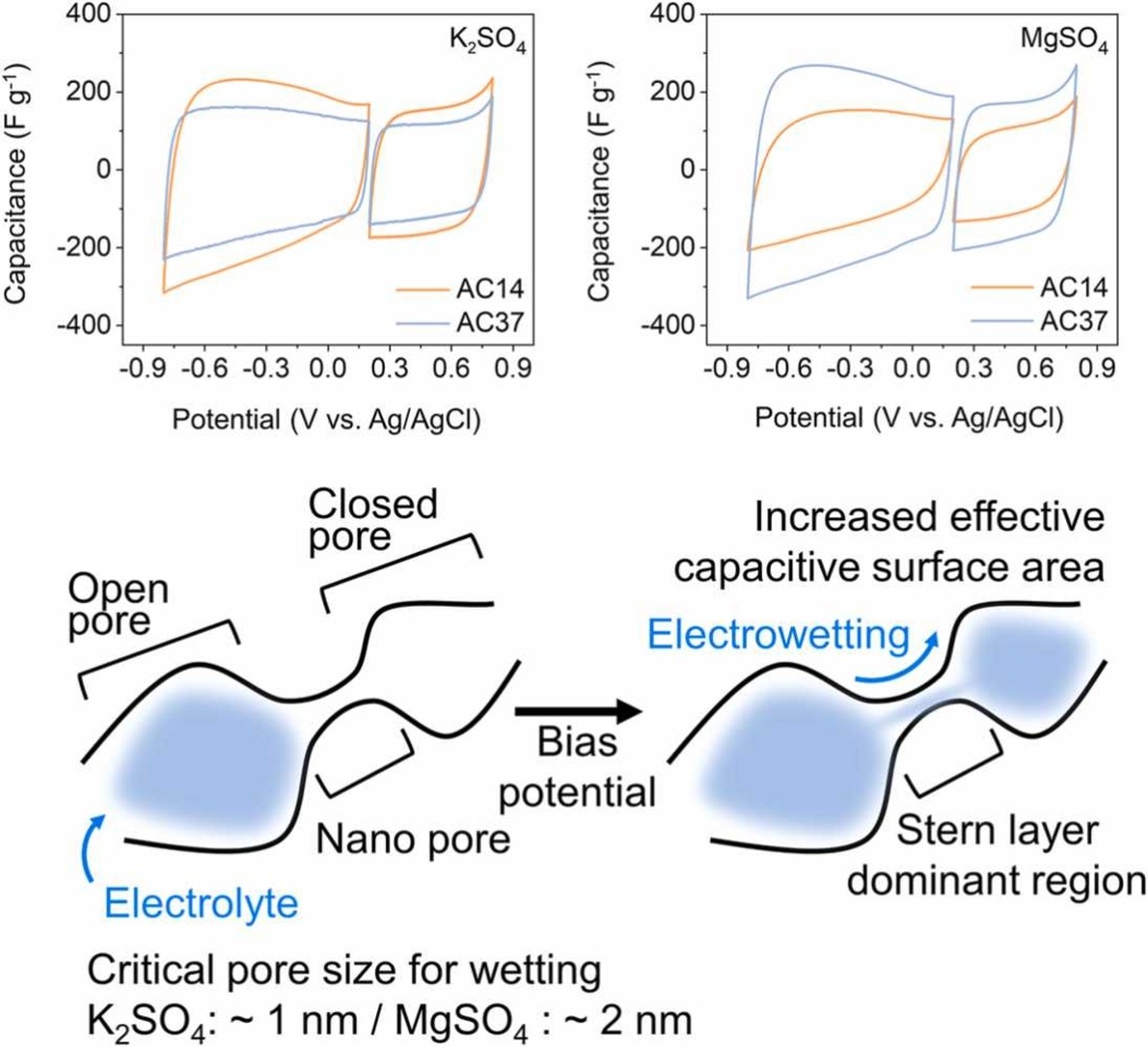
Electrowetting enables ion infiltration and capacitance boost.
GA, UNITED STATES, December 23, 2025 /EINPresswire.com/ -- Improving the capacitance of supercapacitors requires gaining control over ion behavior inside carbon nanopores. This study demonstrates that electrowetting—voltage-driven electrolyte infiltration—can both increase active surface area and restructure the electric double layer, resulting in significantly enhanced charge storage. Carbon electrodes with tuned pore sizes were paired with monovalent and multivalent cations to identify optimal pore–ion combinations. The work reveals that mesopores combined with multivalent ions support stronger ion packing and dual-ion adsorption, delivering higher capacitance than systems relying solely on micropores or monovalent ions. The results establish electrowetting as a viable pathway to surpass conventional strategies focused only on surface area enlargement or ion-distance reduction.
Supercapacitors are valued for rapid charge–discharge performance but lag behind batteries in energy density due to limited charge storage within nanopores. Activated carbon remains a preferred electrode material, yet its microporous architecture restricts ion accessibility and raises uncertainty over how pore size, ion type and double-layer structure collectively influence capacitance. Existing studies mainly examine monovalent ions in sub-nanometer pores, leaving multivalent electrolytes and mesopore environments poorly understood. The paper addresses this knowledge gap by systematically comparing ion transport and electrowetting behavior across different pore scales and charge carriers, offering insights that may guide future device optimization. Due to these challenges, deeper research into pore-ion interactions and electrowetting is needed.
Researchers from Korea University, KAIST and collaborating institutes reported on eScience Energy (2025) a detailed investigation into how electrowetting modulates charge storage inside carbon nanopores. The team engineered carbon electrodes with 1.4 nm and 3.7 nm pores and compared their electrochemical behavior in monovalent (K⁺/Na⁺) and multivalent (Mg²⁺/Zn²⁺) sulfate solutions. Their findings identify electrowetting-induced dual-ion adsorption as the key driver behind capacitance enhancement, enabling mesopores with multivalent ions to outperform traditional micropore-dominated systems.
The study produced two activated carbons—AC14 (microporous, 1.4 nm dominant) and AC37 (mesoporous, 3.7 nm dominant). Structural characterizations using field-emission scanning electron microscopy (FE-SEM), transmission electron microscopy (TEM), X-ray diffraction (XRD), raman spectroscopy (Raman) and X-ray photoelectron spectroscopy (XPS) confirmed similar defect and chemical features, isolating pore size as the main variable. Electrochemical analysis revealed distinct trends: monovalent ions favored micropores, whereas multivalent ions benefited from larger pore geometries. Capacitance in AC37 with Mg²⁺ reached ~237 F g⁻¹, notably higher than other tested combinations. Inductively coupled plasma optical emission spectrometry (ICP-OES) and electrochemical quartz crystal microbalance (EQCM) experiments revealed strong dual-ion adsorption and significant mass increase in high-performance configurations, indicating active ion insertion driven by electrowetting. Molecular dynamics simulations further illustrated how applied voltage enables water and ions to penetrate hydrophobic nanopores, reducing ion desolvation barriers and promoting a Stern-layer-dominant electric double layer. Systems pairing micropores with monovalent ions or mesopores with multivalent ions achieved optimal capacitance, verifying pore–ion synergy as a governing principle of energy storage.
"Most strategies aim to increase surface area, yet we found that what truly matters is how ions behave under confinement," the authors noted. They emphasize that electrowetting transforms previously inaccessible pores into active storage sites, improving not just the amount of charge stored but the way ions pack near the carbon interface. "Matching pore size with suitable electrolyte ions allows the electric double layer to compress into a high-density Stern layer, unlocking capacitance far beyond conventional assumptions."
The insights demonstrate that optimizing electrowetting offers a new design rule for next-generation supercapacitors. Rather than relying solely on pore volume expansion, future materials may prioritize pore–ion compatibility engineering, particularly using mesopores with multivalent electrolytes to maximize charge density. The findings could accelerate the development of compact, high-power energy storage for wearables, grid buffering and fast-charge electronics. By refining nanopore architecture and electrolyte chemistry together, the study provides a blueprint for scalable supercapacitor optimization beyond traditional material-driven performance limits.
References
DOI
10.1016/j.esen.2025.100006
Original Source URL
https://doi.org/10.1016/j.esen.2025.100006
Funding information
This work is funded by Korea Institute of Science and Technology (KIST) Institutional Program (2V09840–23-P025).
Lucy Wang
BioDesign Research
email us here
Legal Disclaimer:
EIN Presswire provides this news content "as is" without warranty of any kind. We do not accept any responsibility or liability for the accuracy, content, images, videos, licenses, completeness, legality, or reliability of the information contained in this article. If you have any complaints or copyright issues related to this article, kindly contact the author above.
